
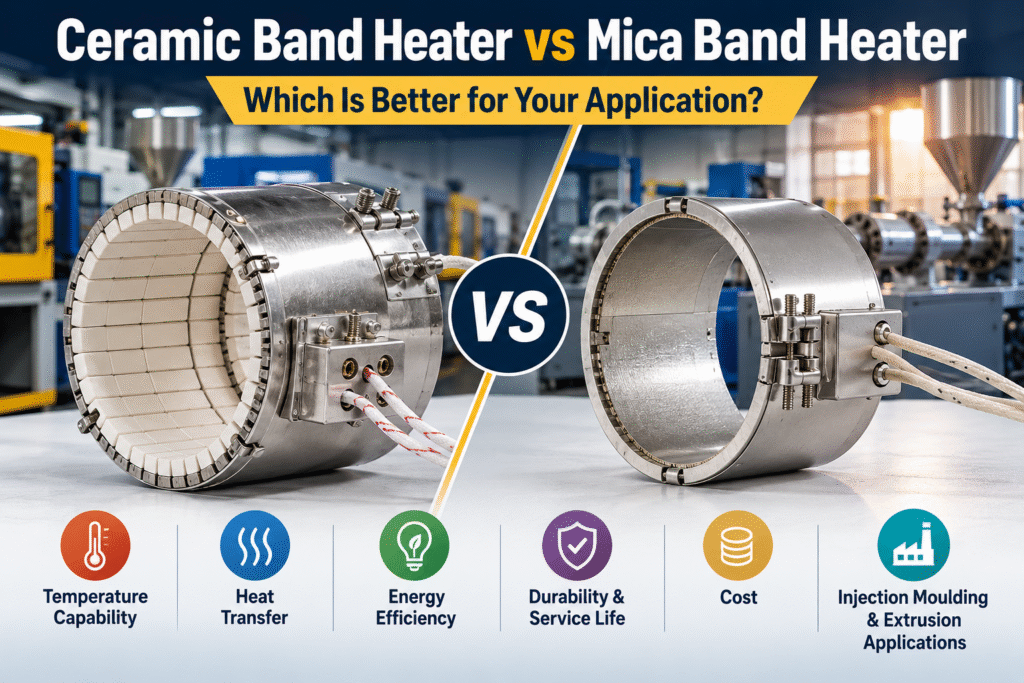
Choosing between a ceramic band heater and a mica band heater can directly affect heating performance, temperature control, energy use, maintenance requirements, and production reliability.
Both types of industrial band heaters are widely used for heating cylindrical surfaces such as barrels, dies, pipes, and processing equipment. They are particularly common in plastic processing, injection moulding and extrusion machinery.
However, ceramic and mica band heaters differ in their construction, heat-transfer characteristics, operating capabilities, cost, and suitability for different applications.
So, ceramic band heater vs mica band heater—which one should you choose?
The answer depends on your operating temperature, wattage requirement, machine design, duty cycle, budget, and working conditions.
This guide from Antique Heating Elements (AHE) explains the differences to help engineers, maintenance teams, OEMs, and industrial buyers select the right heater for their application.
What Is the Main Difference Between Ceramic and Mica Band Heaters?
The main difference is their insulation and heating construction. A mica band heater uses mica as electrical insulation and primarily depends on close contact with the heated surface. A ceramic band heater uses ceramic insulating elements and is generally better suited to demanding applications requiring higher operating temperatures and higher heat output.
Neither heater is automatically better for every application.
What Is a Ceramic Band Heater?
A ceramic band heater is an industrial electric heater designed to fit around cylindrical components such as machine barrels and pipes.
The resistance heating element is supported and electrically insulated by ceramic components. The assembly is enclosed within a metal sheath, with the construction designed to deliver heat efficiently to the required surface.
Unlike conventional mica band heaters, ceramic band heaters can transfer a meaningful portion of their heat through radiation as well as conduction. Their construction makes them particularly useful where the application requires higher temperatures or demanding continuous operation.
Common Applications of Ceramic Band Heaters
Ceramic band heaters are commonly considered for:
- Plastic injection moulding machines
- Extrusion machinery
- Plastic processing equipment
- Blow moulding machines
- Barrels and cylinders
- Dies and processing equipment
- Industrial machinery requiring concentrated heating
- Continuous-production applications
For application-specific solutions, explore our ceramic heater manufacturer page:
https://www.antiqueheatingelements.com/ceramic-heater-manufacturer/
What Is a Mica Band Heater?
A mica band heater is another commonly used industrial band heater. It typically consists of a resistance heating element electrically insulated by mica and enclosed inside a metallic sheath.
The heater is clamped tightly around the barrel or cylindrical surface being heated. Good contact between the heater and the workpiece is therefore extremely important for effective heat transfer and heater life.
Mica band heaters provide a relatively simple, compact and economical heating solution for many industrial machines.
Common Applications of Mica Band Heaters
Mica band heaters are commonly used in:
- Injection moulding machines
- Plastic processing machinery
- Extrusion equipment
- Packaging equipment
- Cylinders and barrels
- Dies
- Nozzles
- Industrial processing equipment
Where moderate operating conditions and cost-effective heating are priorities, mica heaters can be an excellent option.
Explore our mica heater manufacturer page:
https://www.antiqueheatingelements.com/mica-heater-manufacturer/
Ceramic Band Heater vs Mica Band Heater – Quick Comparison
Understanding the basic differences makes heater selection easier.
| Parameter | Ceramic Band Heater | Mica Band Heater |
|---|---|---|
| Insulation | Ceramic insulation | Mica insulation |
| Heat Transfer | Combination of conduction and radiation | Primarily conduction through surface contact |
| Temperature Capability | Generally suitable for higher-temperature applications | Generally suited to moderate-temperature applications |
| Watt Density | Can support higher watt-density designs | Generally lower than comparable ceramic designs |
| Energy Performance | Can reduce outward heat loss when properly insulated/designed | Performance depends strongly on good surface contact |
| Surface Contact | Some heat transfer can occur through radiation | Close barrel contact is especially important |
| Durability | Well suited to demanding applications when correctly specified | Reliable for suitable moderate-duty applications |
| Initial Cost | Generally higher | Generally lower |
| Injection Moulding | Excellent for demanding/high-heat applications | Very suitable for many standard applications |
| Extrusion | Often preferred for demanding continuous barrel heating | Suitable where operating requirements remain within design limits |
| Best For | High-temperature, higher-output and demanding applications | Economical, conventional industrial heating |
Important: Actual temperature capability, watt density and service life depend on the heater’s construction, dimensions, voltage, wattage, installation, control system and operating environment. Heater selection should therefore be based on application data rather than a generic maximum rating.
7 Key Differences Between Ceramic Band Heaters and Mica Band Heaters
1. Construction
Construction is one of the biggest differences between these two heaters.
A mica band heater uses mica as an electrical insulating material between the resistance element and metal sheath. The complete assembly is designed to clamp closely around the surface being heated.
A ceramic band heater uses ceramic insulating components around the resistance heating element.
This difference in construction affects operating capability, heat transfer, watt density and overall application suitability.
2. Operating Temperature
Ceramic band heaters are generally selected when an application requires higher operating temperatures.
Mica band heaters are commonly used for standard or moderate-temperature industrial heating applications.
However, buyers should not select a heater based only on a maximum temperature printed on a product page.
The actual safe operating capability depends on factors including:
- Heater construction
- Watt density
- Barrel temperature
- Heater dimensions
- Electrical loading
- Ambient conditions
- Cycling frequency
- Installation
- Temperature control
For this reason, provide your required operating temperature when requesting a heater.
3. Watt Density
Watt density describes the amount of heating power applied over a particular heater surface area.
Ceramic construction can generally accommodate higher watt-density applications than conventional mica construction.
This can be useful when substantial heating power must be delivered through a relatively limited barrel area.
However, higher watt density is not automatically better.
An incorrectly selected watt density can cause excessive heater temperature, premature failure, poor temperature control, or damage to the process.
The wattage and watt density should therefore be calculated according to the actual machine and process requirement.
4. Heat Transfer
This is an important technical difference in the ceramic heater vs mica heater comparison.
Mica band heaters rely heavily on conductive heat transfer, which makes close contact between the heater and barrel extremely important.
Ceramic band heaters can transfer heat through both conduction and thermal radiation, depending on their construction and installation.
This characteristic can make ceramic band heaters particularly useful for demanding barrel-heating applications.
5. Energy Efficiency
Is a Ceramic Band Heater More Energy Efficient Than a Mica Band Heater?
It can be under the right operating conditions, but there is no universal percentage improvement that applies to every installation.
A properly designed ceramic band heater can limit outward heat loss and deliver heat effectively in demanding applications. But actual energy consumption depends on much more than heater type.
Important factors include:
- Heater insulation
- Barrel temperature
- Ambient temperature
- Machine design
- Heater fit
- Controller settings
- Process heat demand
- Production cycle
- Heater wattage
Therefore, claims such as “ceramic heaters always save X% electricity” should be treated carefully unless they are supported by testing on the specific machine.
6. Durability and Service Life
Ceramic band heaters are often chosen for demanding, higher-temperature and continuous-duty applications.
However, heater life cannot be predicted solely from whether the heater is ceramic or mica.
Service life can be affected by:
- Operating temperature
- Watt density
- Voltage
- Heater fit
- Installation quality
- Frequent thermal cycling
- Material leakage
- Moisture and contamination
- Terminal damage
- Wiring condition
- Temperature controller performance
A correctly specified and installed mica heater may provide excellent service in an application for which it was designed.
Similarly, even a high-quality ceramic heater can fail prematurely if it is incorrectly installed or operated outside its design conditions.
7. Initial Cost vs Long-Term Operating Requirements
Mica band heaters generally have a lower initial purchase cost.
That makes them attractive for applications where operating temperatures and heat loads are moderate and where mica construction can comfortably meet process requirements.
Ceramic band heaters normally have a higher initial cost because of their construction.
However, in demanding production environments, the decision should consider more than purchase price.
Buyers should evaluate:
Purchase cost + energy requirements + production conditions + expected maintenance + machine downtime + replacement frequency.
The cheapest heater initially is not necessarily the lowest-cost heating solution over the complete production cycle.
Ceramic Band Heater vs Mica Band Heater for Injection Moulding Machines
Injection moulding is one of the most common applications for industrial band heaters.
The heaters installed around the machine barrel help maintain the temperature required for processing polymer material.
Which Band Heater Is Best for Injection Moulding?
Both ceramic and mica band heaters can be used for injection moulding machines.
A mica band heater may be suitable where:
- Operating temperature is moderate
- Heat demand is conventional
- Good barrel contact can be maintained
- Initial cost is important
- The existing machine is designed around mica heaters
A ceramic band heater may be preferred where:
- Higher heat output is required
- Operating temperatures are more demanding
- Higher watt density is required
- The machine operates for long production periods
- Heat loss needs greater consideration
The correct choice should ultimately be based on the machine’s barrel dimensions, required wattage, voltage, temperature and production conditions.
Which Band Heater Is Better for Extrusion Machines?
Extrusion machines frequently operate for extended periods and require controlled heating along different barrel zones.
For demanding extrusion applications, ceramic band heaters are often an attractive choice because they can accommodate higher-temperature and higher-output requirements.
Mica band heaters can still be suitable where the extrusion process operates within their designed temperature and watt-density range.
An extrusion heater should therefore be selected according to:
- Barrel diameter
- Heater width
- Number of heating zones
- Voltage
- Wattage
- Required operating temperature
- Material being processed
- Production duty cycle
- Existing heater specifications
Replacing a failed heater solely by matching its physical size is not always enough. Electrical and thermal specifications should also be checked.
When Should You Choose a Ceramic Band Heater?
Consider a ceramic band heater when your application involves:
- Higher operating temperatures
- Higher watt-density requirements
- Continuous industrial production
- High heat demand
- Injection moulding under demanding conditions
- Extrusion barrel heating
- Larger industrial barrels
- Applications where reducing outward heat loss is important
Ceramic band heaters are especially useful where standard band-heater construction cannot comfortably meet the thermal requirements.
When Should You Choose a Mica Band Heater?
Consider a mica band heater when:
- Your process operates at moderate temperatures
- Required watt density is within mica heater design limits
- Close heater-to-barrel contact can be maintained
- Initial cost is an important consideration
- The machine already uses mica heaters successfully
- You need a straightforward replacement heating solution
- The application does not require the higher thermal capability of ceramic construction
There is little benefit in paying for a more demanding heater construction if a correctly designed mica heater can reliably meet the process requirement.
Ceramic Band Heater vs Mica Band Heater: Which Is More Energy Efficient?
Ceramic band heaters can offer advantages in demanding applications because of their insulation and heat-transfer characteristics.
However, heater efficiency is a system issue, not simply a material issue.
A poorly selected ceramic heater can waste energy, while a correctly sized and installed mica heater can perform efficiently within its intended application.
For better energy performance, consider:
- Correct heater sizing
- Proper insulation
- Accurate temperature control
- Good installation
- Correct wattage
- Appropriate heater construction
- Minimizing unnecessary barrel heat loss
When energy consumption is a major concern, evaluate the entire heating system rather than replacing one heater type solely because it is advertised as more efficient.
Which Band Heater Lasts Longer?
There is no fixed number of operating hours that applies to every ceramic or mica band heater.
In demanding high-temperature applications, properly designed ceramic heaters may provide advantages. In moderate applications, a properly specified mica heater may also provide reliable long-term service.
The most important factors affecting heater life include:
Correct heater selection + correct watt density + proper installation + accurate temperature control + clean operating conditions.
A heater should also be inspected when repeated failures occur. Frequent heater replacement can sometimes indicate an underlying machine, installation or process problem rather than poor heater quality alone.
Ceramic Band Heater Price vs Mica Band Heater Price
Which Band Heater Is Cheaper?
Mica band heaters are generally less expensive initially than comparable ceramic band heaters.
However, asking only for the “ceramic band heater price” or “mica band heater price” without specifications is not enough to obtain an accurate quotation.
Band heater pricing depends on:
- Inside diameter (ID)
- Width
- Voltage
- Wattage
- Watt density
- Heater construction
- Terminal configuration
- Lead-wire requirement
- Cut-outs or holes
- Quantity
- Application
- Custom manufacturing requirements
For an accurate quotation, send the heater drawing or complete specifications along with the machine application.
How to Select the Right Band Heater
Before ordering a ceramic or mica band heater, provide your heater manufacturer with as much application information as possible.
Band Heater Buyer Checklist
| Specification | Information to Provide |
|---|---|
| Heater Type | Ceramic / Mica / Need recommendation |
| Inside Diameter | ___ mm |
| Width | ___ mm |
| Voltage | ___ V |
| Wattage | ___ W |
| Operating Temperature | ___ °C |
| Application | Injection moulding / Extrusion / Other |
| Material/Barrel Being Heated | ___ |
| Terminal Type | ___ |
| Lead Wire | Required / Not required |
| Thermocouple/Sensor | Required / Not required |
| Quantity | ___ Nos. |
| Working Environment | ___ |
If an old heater is being replaced, providing its nameplate details, dimensions and clear photographs can also help identify the requirement.
Common Reasons Band Heaters Fail
Repeated band-heater failure should not automatically be blamed on the heating element.
Common causes can include:
Incorrect Heater Fit
A mica band heater that does not make proper contact with the barrel may develop localized overheating.
Loose Clamping
Band heaters should be installed according to the manufacturer’s recommendations. Loose installation can affect heat transfer.
Incorrect Watt Density
Excessive watt density for the application can shorten heater life.
Voltage Mismatch
Operating a heater at an incorrect voltage can significantly affect its electrical loading and performance.
Material Contamination
Molten plastic, oil, moisture and other contaminants entering the heater or terminals can contribute to failure.
Damaged Terminals or Lead Wires
Loose electrical connections, damaged leads and poor terminal protection can cause electrical problems.
Incorrect Temperature Control
A failed sensor or improperly configured temperature controller can allow the heater to operate outside intended conditions.
Selecting the correct industrial heater is therefore only one part of achieving reliable heating performance.
Explore AHE’s industrial heating solutions:
https://www.antiqueheatingelements.com/industrial-heater/
Ceramic Band Heater vs Mica Band Heater – Final Verdict
So, which is better: ceramic band heater or mica band heater?
Neither is universally better.
The correct choice depends on the application.
| Your Requirement | Recommended Heater |
|---|---|
| Higher-temperature demanding application | Ceramic Band Heater |
| Higher heat-output requirement | Ceramic Band Heater |
| Higher watt-density requirement | Ceramic Band Heater |
| Cost-sensitive standard heating | Mica Band Heater |
| Moderate-temperature application | Mica Band Heater |
| Conventional barrel heating | Mica may be sufficient |
| Continuous demanding production | Ceramic often preferred |
| Injection moulding | Depends on process temperature and heat load |
| Extrusion | Ceramic often preferred for demanding conditions; application should be evaluated |
Choose a Ceramic Band Heater When:
Your machine requires higher temperature capability, higher heat output, higher watt density or demanding continuous operation.
Choose a Mica Band Heater When:
Your application has moderate heating requirements, close barrel contact can be maintained and you want an economical industrial heating solution.
The best heater is therefore the heater correctly engineered for your machine—not simply the heater with the highest rating.
Ceramic & Mica Band Heater Manufacturer in India – Antique Heating Elements
Antique Heating Elements (AHE) is an industrial heater manufacturer based in Ghaziabad, Uttar Pradesh, India.
AHE provides industrial heating solutions for applications across plastic processing, packaging and other industrial machinery.
Depending on application requirements, heaters can be selected or customized around specifications such as:
- Diameter and width
- Voltage
- Wattage
- Operating conditions
- Terminal arrangement
- Lead configuration
- Machine application
In addition to ceramic and mica heaters, buyers looking for alternative heating solutions can explore our industrial heater range and cartridge heaters for different machine and process-heating requirements.
Need help choosing between a Ceramic Band Heater and Mica Band Heater?
Contact Antique Heating Elements with your heater dimensions, voltage, wattage, operating temperature, quantity and machine application for technical guidance and quotation.
Frequently Asked Questions
1. What is the difference between a ceramic band heater and mica band heater?
The primary difference is their construction and insulation. Ceramic band heaters use ceramic insulating components and are generally suited to higher-temperature and higher-output applications. Mica band heaters use mica insulation and are commonly selected for economical, moderate-temperature barrel heating.
2. Which is better: ceramic or mica band heater?
Neither is universally better. Ceramic band heaters are often preferred for demanding high-temperature and higher-watt-density applications, while mica band heaters can be more economical for conventional moderate-temperature heating.
3. Which band heater is suitable for injection moulding machines?
Both types can be used. The appropriate choice depends on barrel temperature, wattage, heater dimensions, duty cycle, heat demand and existing machine design.
4. Can ceramic band heaters be used on extrusion machines?
Yes. Ceramic band heaters are commonly suitable for extrusion barrel heating, particularly where continuous operation and demanding heat loads are involved.
5. Are ceramic band heaters more energy efficient?
Ceramic heater construction can provide energy-performance advantages in certain applications, but actual energy consumption depends on heater design, insulation, machine conditions, temperature, controls and process requirements.
6. Why do mica band heaters fail?
Possible causes include poor surface contact, loose installation, incorrect watt density, contamination, incorrect voltage, damaged terminals, excessive temperature or unsuitable heater selection.
7. How do I calculate the required band heater wattage?
Required wattage depends on the mass and material being heated, target temperature, required heat-up time, process heat losses and operating conditions. For new applications, a thermal calculation should be performed rather than selecting wattage from heater dimensions alone.
8. Can ceramic and mica band heaters be customized?
Yes. Industrial band heaters can be manufactured according to application requirements such as diameter, width, voltage, wattage, terminal arrangement and other design requirements, subject to manufacturing feasibility.
9. What information is required when ordering a band heater?
Provide the inside diameter, width, voltage, wattage, operating temperature, terminal configuration, lead requirement, quantity and machine/application details.
10. How do I choose a band heater manufacturer in India?
Evaluate technical capability, material and construction quality, customization support, specification clarity, application knowledge, quality control and after-sales support rather than comparing price alone.
