
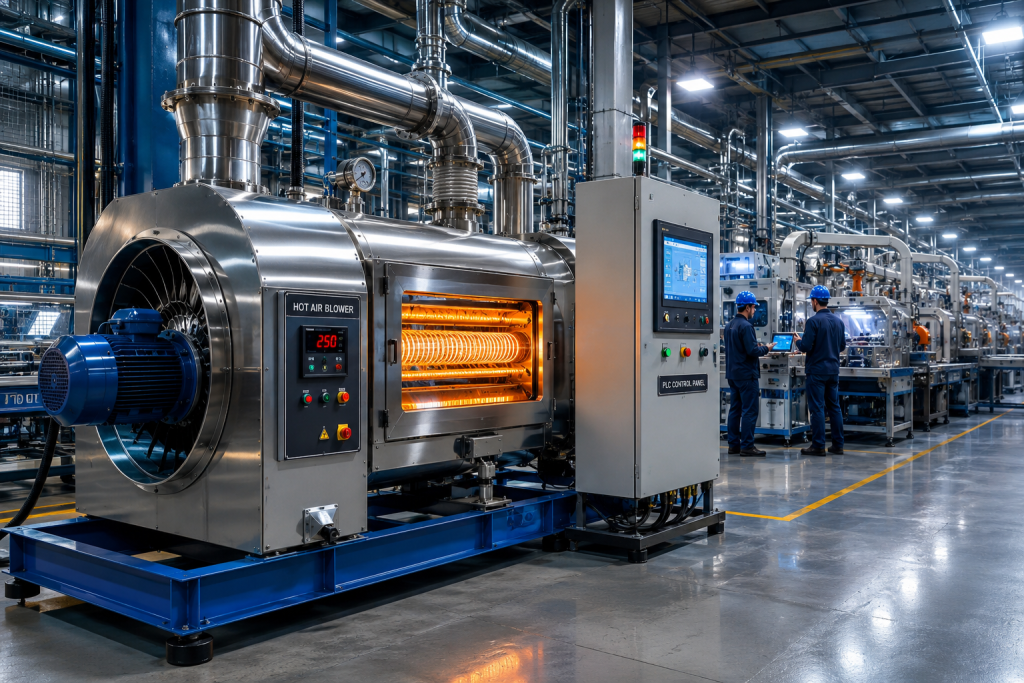
Industrial manufacturing processes require precise temperature control to achieve consistent product quality, improve production efficiency, and reduce energy consumption. One of the most effective solutions for delivering controlled heated air is the industrial hot air blower.
From plastic processing and food packaging to pharmaceuticals, textiles, automotive manufacturing, and electronics, hot air blowers are indispensable in modern industries. They provide a continuous stream of heated air for drying, shrinking, curing, preheating, sterilizing, and maintaining process temperatures.
As industries increasingly focus on automation, energy efficiency, and product consistency, the demand for advanced electric hot air blowers continues to grow. Modern systems combine powerful heating elements, efficient blowers, intelligent PID temperature controllers, and robust stainless steel construction to deliver reliable performance even under demanding operating conditions.
This comprehensive guide explains everything you need to know about industrial hot air blowers, including their working principle, components, types, applications, advantages, and how to choose the right model for your business.
What Is a Hot Air Blower?
A hot air blower is an industrial heating device that combines an electric heating element with a blower or fan to produce a controlled stream of heated air. It is widely used in manufacturing for drying, heating, curing, shrinking, sterilizing, and maintaining process temperatures.
Unlike traditional heating systems that warm a surface or liquid, hot air blowers heat moving air and deliver it directly to the required application, ensuring fast, uniform, and energy-efficient heating.
Why Industrial Hot Air Blowers Are Essential
Manufacturers across industries rely on hot air blowers because they offer:
- Fast and uniform heating
- Precise temperature control
- High energy efficiency
- Clean electric heating with no combustion gases
- Continuous operation for industrial production
- Reduced production time
- Improved product quality
- Low maintenance requirements
These advantages make hot air blowers an ideal choice for industries that require reliable process heating.
What Is an Industrial Hot Air Blower?
An industrial hot air blower is an electrically powered heating system designed to generate and circulate hot air for industrial processes. It consists of a heating chamber containing electric heating elements and a blower that forces air across the heated elements.
The heated air is then directed through ducts, nozzles, process chambers, ovens, drying tunnels, or production equipment.
Depending on the application, industrial hot air blowers can deliver air temperatures ranging from ambient levels to over 650°C, with custom systems capable of even higher temperatures.
They are available in various power ratings, airflow capacities, and configurations to suit different industries and production requirements.
How Does a Hot Air Blower Work?
The operation of an industrial hot air blower is based on the principle of electrical resistance heating combined with forced convection.
Step 1: Electrical Energy Conversion
When electrical power is supplied, current passes through resistance heating elements such as finned tubular heaters or ceramic heating elements.
The electrical resistance converts electrical energy into heat.
Step 2: Air Intake
An industrial blower or centrifugal fan draws fresh air into the heating chamber.
The airflow is carefully designed to maximize heat transfer while preventing overheating of the heating elements.
Step 3: Heat Transfer
As the air passes over the heated elements, it absorbs thermal energy through convection.
The temperature of the moving air increases rapidly while maintaining consistent airflow.
Step 4: Temperature Regulation
Modern industrial hot air blowers are equipped with PID temperature controllers and thermocouples or RTD sensors.
These systems continuously monitor outlet temperature and adjust power to maintain precise heating conditions.
Step 5: Hot Air Delivery
The heated air is discharged through ducts, flexible hoses, nozzles, or process equipment, depending on the application.
This controlled airflow ensures consistent heating throughout the manufacturing process.
Main Components of an Industrial Hot Air Blower
Understanding the key components helps in selecting the right equipment and maintaining long-term performance.
1. Heating Elements
Heating elements are the heart of the hot air blower.
Common types include:
- Finned tubular heating elements
- Ceramic heating elements
- Tubular heaters
- Coil heaters (special applications)
These elements are selected based on temperature requirements, airflow, and operating conditions.
2. Blower Assembly
The blower forces air through the heating chamber.
Common blower types include:
- Centrifugal blowers
- Axial blowers
- High-pressure blowers
Proper airflow is essential for efficient heat transfer and safe operation.
3. Stainless Steel Heating Chamber
The heating chamber houses the heating elements and directs airflow efficiently.
High-quality systems use stainless steel for corrosion resistance, durability, and long service life.
4. Temperature Sensors
Industrial hot air blowers typically use:
- K-Type Thermocouples
- J-Type Thermocouples
- PT100 RTD Sensors
These sensors provide real-time temperature feedback for accurate process control.
5. PID Temperature Controller
A PID controller automatically regulates heater output to maintain the desired air temperature.
Benefits include:
- Improved product consistency
- Reduced energy consumption
- Faster response time
- Enhanced process stability
6. Control Panel
Industrial control panels may include:
- Digital temperature display
- Power indicators
- Emergency stop button
- Contactor and relay controls
- Overload protection
- Variable airflow controls
Advanced systems can also integrate with PLCs for automated production lines.
7. Safety Features
To ensure safe operation, industrial hot air blowers often include:
- Thermal cut-off protection
- High-temperature safety switches
- Airflow monitoring switches
- Circuit breakers
- Earthing and insulation protection
These features reduce the risk of overheating and electrical faults.
Types of Industrial Hot Air Blowers
Different manufacturing processes require different heating solutions. Selecting the correct type depends on airflow, temperature, pressure, and installation requirements.
1. Electric Hot Air Blower
The most common type, using electric resistance heating elements.
Best For:
- Packaging
- Food processing
- Plastic manufacturing
- Pharmaceuticals
- Electronics
Advantages:
- Clean operation
- Precise temperature control
- Low maintenance
- High efficiency
2. Portable Hot Air Blower
Designed for mobile industrial applications such as on-site drying, shrink wrapping, and maintenance work.
Common Applications:
- Paint drying
- Surface heating
- Construction
- Maintenance workshops
3. Industrial Process Hot Air Blower
Built for continuous operation in demanding manufacturing environments.
Applications:
- Plastic extrusion
- Injection molding
- Chemical processing
- Industrial drying
- Textile finishing
4. High-Temperature Hot Air Blower
Designed for applications requiring elevated temperatures, often above 500°C.
Industries:
- Ceramics
- Glass manufacturing
- Metal processing
- Heat treatment
5. Duct Mounted Hot Air Blower
Installed directly within ducting systems to provide heated airflow for:
- HVAC
- Drying tunnels
- Air handling units
- Industrial ventilation systems
Typical Technical Specifications
Industrial hot air blowers are available in a wide range of specifications.
| Parameter | Typical Range |
| Voltage | 230V, 415V, 440V |
| Power Rating | 1 kW – 200 kW+ |
| Air Temperature | Ambient to 650°C |
| Airflow | Customizable |
| Heating Element | Tubular, Finned Tubular, Ceramic |
| Control | PID Controller / PLC |
| Construction | Stainless Steel |
| Mounting | Floor, Wall, Duct, Custom |
The exact specifications should be selected based on your process temperature, airflow requirements, operating environment, and production capacity.
Key Benefits of Industrial Hot Air Blowers
Industrial hot air blowers offer significant advantages over conventional heating systems:
- Rapid heating response
- Uniform air distribution
- Precise temperature control
- High thermal efficiency
- Continuous-duty operation
- Low maintenance costs
- Energy-efficient electric heating
- Easy integration with automated production lines
- Long service life with robust stainless steel construction
These benefits make industrial hot air blowers a preferred solution for modern manufacturing facilities seeking reliable, repeatable, and energy-efficient process heating.
Industrial Applications of Hot Air Blowers
Industrial hot air blowers are among the most versatile heating systems used across manufacturing industries. Their ability to provide clean, controlled, and uniform hot air makes them essential for drying, curing, heating, shrinking, sterilizing, and maintaining process temperatures.
Let’s explore the major industries where hot air blowers play a crucial role.
1. Plastic Processing Industry
The plastic industry is one of the largest users of industrial hot air blowers. Maintaining the correct temperature is critical for producing defect-free plastic components.
Common Applications
- Injection molding machines
- Extrusion lines
- Blow molding machines
- Thermoforming machines
- Hopper dryers
- Plastic granule drying
- Mold preheating
Benefits
- Faster drying of plastic resins
- Reduced moisture-related defects
- Improved dimensional accuracy
- Better surface finish
- Lower production cycle time
Hot air blowers help maintain stable temperatures, resulting in improved product consistency and reduced material wastage.
2. Food Processing Industry
Food manufacturers require hygienic heating systems that provide clean hot air without introducing contaminants.
Applications
- Food dehydration
- Dry fruit processing
- Spice drying
- Bakery ovens
- Snack manufacturing
- Conveyor drying systems
- Food packaging lines
Advantages
- Hygienic electric heating
- Uniform drying
- Better product quality
- Increased shelf life
- Reduced moisture content
Stainless steel hot air blowers are preferred because they meet hygiene requirements and resist corrosion.
3. Pharmaceutical Industry
Pharmaceutical production demands highly accurate temperature control to ensure product quality and compliance with regulatory standards.
Applications
- Tablet drying
- Capsule manufacturing
- Sterilization chambers
- Laboratory equipment
- Cleanroom HVAC systems
- Process air heating
Benefits
- Stable temperature control
- Reduced contamination risk
- Improved process reliability
- GMP-friendly operation
4. Chemical Industry
Chemical manufacturing processes often involve drying powders, heating reactors, or maintaining specific process temperatures.
Applications
- Chemical dryers
- Mixing vessels
- Powder processing
- Solvent evaporation
- Reaction chambers
- Storage tank heating
Benefits
- Uniform process heating
- Increased productivity
- Reduced downtime
- Improved process safety
5. Packaging Industry
Hot air blowers are widely used in packaging applications where controlled heating is required for sealing, shrinking, or drying.
Applications
- Shrink wrapping
- Label drying
- Induction sealing support
- Heat tunnels
- Container sealing
- Carton drying
Benefits
- Stronger packaging quality
- Faster production speed
- Better product appearance
- Lower rejection rates
6. Textile Industry
The textile sector uses industrial hot air blowers during multiple manufacturing stages.
Applications
- Fabric drying
- Textile printing
- Dye curing
- Heat setting
- Coating processes
Consistent airflow helps maintain fabric quality while reducing production time.
7. Automotive Industry
Automotive manufacturers use hot air blowers for surface preparation and component drying.
Applications
- Paint curing
- Adhesive drying
- Plastic component heating
- Battery manufacturing
- Interior component processing
8. Electronics Industry
Electronic manufacturing requires controlled heating for delicate components.
Applications
- PCB drying
- Conformal coating curing
- Moisture removal
- Heat shrinking
- Component preheating
9. Printing Industry
Industrial hot air blowers accelerate ink drying and improve print quality.
Applications
- Offset printing
- Digital printing
- Screen printing
- Flexographic printing
Advantages of Industrial Hot Air Blowers
High Heating Efficiency
Modern hot air blowers convert electrical energy into heat with excellent efficiency, reducing operating costs and minimizing heat loss.
Rapid Heating
Industrial hot air blowers reach operating temperature quickly, allowing production lines to start faster and increasing overall productivity.
Uniform Heat Distribution
Forced-air circulation ensures even heat transfer, eliminating cold spots and improving process consistency.
Precise Temperature Control
Integrated PID controllers maintain accurate temperatures, improving product quality and reducing process variation.
Continuous Operation
Industrial-grade blowers are designed for 24/7 operation, making them suitable for demanding manufacturing environments.
Low Maintenance
With fewer moving parts and durable heating elements, maintenance requirements are relatively low compared to combustion-based systems.
Environmentally Friendly
Electric hot air blowers produce no direct combustion emissions, making them suitable for clean manufacturing facilities.
Hot Air Blower vs Air Heater
Many buyers use these terms interchangeably, but they serve different purposes.
| Feature | Hot Air Blower | Air Heater |
| Air Movement | Built-in blower or fan | Requires external airflow or duct system |
| Primary Function | Delivers heated air directly | Heats air inside ducts or chambers |
| Best Applications | Drying, shrinking, curing | HVAC, process heating, air handling |
| Portability | Available in portable models | Usually fixed installation |
| Air Pressure | Higher | Lower |
Hot Air Blower vs Heat Gun
| Feature | Hot Air Blower | Heat Gun |
| Capacity | Industrial | Handheld |
| Temperature Stability | Excellent | Moderate |
| Duty Cycle | Continuous | Intermittent |
| Airflow | High | Low |
| Industrial Use | Yes | Limited |
Heat guns are suitable for light maintenance tasks, whereas industrial hot air blowers are engineered for continuous production.
How to Choose the Right Hot Air Blower
Selecting the right blower depends on your process requirements rather than just power rating.
Heating Capacity
Calculate the required kilowatts (kW) based on:
- Airflow volume
- Desired outlet temperature
- Ambient conditions
- Heat losses
An undersized blower may fail to achieve target temperatures, while an oversized unit wastes energy.
Temperature Range
Determine the maximum operating temperature required for your application. Different heating elements and materials are suitable for different temperature ranges.
Airflow Requirements
Airflow is typically measured in cubic meters per hour (m³/h) or cubic feet per minute (CFM).
Higher airflow is ideal for:
- Large drying chambers
- Packaging tunnels
- HVAC systems
Lower airflow is suitable for localized process heating.
Power Supply
Select the correct electrical configuration based on your facility.
Typical options include:
- 230V Single Phase
- 415V Three Phase
- 440V Industrial Supply
Heating Element Material
The choice of heating element depends on operating conditions.
Common materials include:
- Stainless Steel 304
- Stainless Steel 316
- Incoloy 800
- Ceramic Heating Elements
Control System
Choose a system with:
- PID Temperature Controller
- Thermocouple or RTD Sensor
- PLC Compatibility
- Digital Display
- Safety Alarms
Advanced control systems improve process stability and energy efficiency.
Energy-Saving Tips
Reducing energy consumption not only lowers operating costs but also extends equipment life.
Best practices include:
- Insulate ducts and heating chambers.
- Use PID controllers for precise temperature regulation.
- Perform preventive maintenance regularly.
- Keep filters and blowers clean.
- Avoid unnecessary overheating.
- Select the correct heater size for the application.
- Monitor airflow to ensure efficient heat transfer.
Why Choose Antique Heating Elements (AHE)?
Antique Heating Elements (AHE) manufactures high-performance industrial hot air blowers designed for demanding applications across plastics, food processing, pharmaceuticals, packaging, textiles, and chemical industries.
Our Advantages
- Custom-built solutions
- Stainless steel construction
- High-efficiency heating elements
- Energy-efficient designs
- Precision temperature control
- Reliable after-sales support
- Fast manufacturing and delivery
Whether you require a standard hot air blower or a fully customized heating solution, AHE provides products engineered for reliability, efficiency, and long service life.
Related Articles:
- Complete Guide to Industrial Heaters
- Air Heater: Working, Types, Applications & Benefits
- Tubular Heaters: Working, Applications & Benefits
- Immersion Heater: Types, Applications & Selection Guide
- Ceramic Band Heater: Energy-Efficient Heating Solution
- Complete Guide to Cartridge Heaters
Installation Guide for Industrial Hot Air Blowers
Proper installation is critical to ensure the safety, efficiency, and long-term performance of an industrial hot air blower. Incorrect installation can reduce heating efficiency, increase power consumption, and shorten equipment life.
Installation Best Practices
Choose the Right Location
Install the hot air blower in a clean, dry, and well-ventilated area. Ensure there is sufficient clearance around the unit for maintenance and airflow.
Secure Mounting
Depending on the application, the blower may be floor-mounted, wall-mounted, or integrated into ductwork. Verify that the mounting structure can support the equipment’s weight and operating conditions.
Electrical Connection
- Use the recommended supply voltage (230V, 415V, or as specified).
- Ensure proper earthing.
- Install suitable MCBs/MCCBs and overload protection.
- Use cables of the correct size based on current rating.
Airflow Management
Maintain unobstructed air intake and outlet paths. Restricted airflow can cause overheating and reduce heating performance.
Temperature Controller Setup
Configure the PID temperature controller and verify the thermocouple or RTD sensor placement before commissioning.
Trial Run
Perform a no-load test to confirm:
- Stable airflow
- Correct temperature rise
- Proper operation of safety devices
- No abnormal vibration or noise
Preventive Maintenance
Routine maintenance improves efficiency and extends the service life of industrial hot air blowers.
Daily Checks
- Inspect airflow
- Check for unusual sounds
- Monitor outlet temperature
- Verify controller readings
Weekly Checks
- Clean filters
- Remove dust from blower housing
- Inspect wiring for loose connections
Monthly Checks
- Tighten electrical terminals
- Check blower motor condition
- Inspect heating elements
- Test safety cut-offs
Annual Maintenance
- Calibrate temperature sensors
- Test insulation resistance
- Replace worn bearings if required
- Perform complete electrical inspection
Common Problems & Troubleshooting
| Problem | Possible Cause | Recommended Solution |
| No Heating | Burnt heating element, no power supply | Check voltage and replace faulty element |
| Low Temperature | Incorrect PID settings, low voltage | Recalibrate controller and inspect power supply |
| Overheating | Blocked airflow, failed blower | Clean air passages and inspect blower motor |
| Uneven Heating | Dirty heating elements or poor airflow | Clean elements and improve airflow |
| Frequent Tripping | Overload or short circuit | Inspect electrical wiring and protection devices |
| High Power Consumption | Incorrect heater sizing or poor insulation | Optimize heater capacity and improve insulation |
| Excessive Noise | Loose fan, worn bearings | Tighten components or replace bearings |
| Temperature Fluctuation | Faulty thermocouple or PID controller | Replace sensor or recalibrate controller |
How to Increase the Life of an Industrial Hot Air Blower
Following these best practices can significantly extend equipment life:
- Operate within the recommended temperature range.
- Keep filters and ducts clean.
- Avoid switching the unit on and off frequently.
- Use quality PID controllers and sensors.
- Perform regular preventive maintenance.
- Protect the blower from moisture and corrosive environments.
- Schedule annual inspections by qualified technicians.
Frequently Asked Questions (FAQs)
1. What is a hot air blower?
A hot air blower is an industrial heating device that uses electric heating elements and a blower fan to generate a controlled stream of heated air for drying, curing, shrinking, heating, and process applications.
2. How does a hot air blower work?
Electric resistance heating elements heat incoming air while a blower forces the heated air toward the required industrial process.
3. What is the difference between a hot air blower and an air heater?
A hot air blower includes both a heating system and an integrated blower, whereas an air heater generally heats air that is moved by an external fan or duct system.
4. Which industries use industrial hot air blowers?
Plastic processing, food manufacturing, pharmaceuticals, packaging, textiles, automotive, chemical processing, electronics, printing, and HVAC industries.
5. What temperature can a hot air blower achieve?
Depending on the design, industrial hot air blowers can operate from ambient temperature up to approximately 650°C or higher for specialized applications.
6. Are electric hot air blowers energy efficient?
Yes. Modern electric hot air blowers with PID temperature control provide high thermal efficiency and precise heating.
7. Can hot air blowers operate continuously?
Industrial models are designed for continuous-duty operation when properly installed and maintained.
8. What heating elements are used in hot air blowers?
Common heating elements include finned tubular heaters, tubular heaters, ceramic heaters, and coil heaters.
9. How do I select the correct hot air blower?
Choose based on airflow, operating temperature, voltage, heating capacity, installation environment, and process requirements.
10. Can hot air blowers be customized?
Yes. Industrial hot air blowers can be custom-built for airflow, wattage, temperature range, duct size, and mounting configuration.
11. What maintenance is required?
Regular cleaning, inspection of electrical connections, calibration of temperature controllers, and checking blower performance.
12. How long does an industrial hot air blower last?
With proper maintenance and operating conditions, industrial hot air blowers can provide reliable service for many years.
13. Are hot air blowers safe?
Yes. Modern systems include thermal cut-outs, overload protection, airflow monitoring, and proper grounding for safe operation.
14. What is the difference between a hot air blower and a heat gun?
A heat gun is a handheld tool for light-duty work, while an industrial hot air blower is designed for continuous, high-capacity industrial heating.
15. Can hot air blowers be used in food processing?
Yes. Stainless steel hot air blowers are widely used for drying, baking, dehydration, and packaging in food processing plants.
16. Are hot air blowers suitable for pharmaceutical applications?
Yes. They provide precise temperature control required for pharmaceutical manufacturing and cleanroom processes.
17. What materials are used in industrial hot air blowers?
Most industrial models use stainless steel housings with heating elements made from stainless steel, Incoloy, or ceramic materials.
18. Can hot air blowers integrate with PLC systems?
Yes. Many industrial models support PLC integration for automated process control.
19. Why is PID temperature control important?
PID controllers maintain stable temperatures, reduce energy consumption, and improve product consistency.
20. Why choose Antique Heating Elements?
Antique Heating Elements designs and manufactures high-performance industrial hot air blowers tailored to customer requirements, delivering reliable performance, energy efficiency, and long service life.
Conclusion
Industrial hot air blowers have become indispensable across modern manufacturing industries due to their efficiency, versatility, and ability to deliver consistent process heating. From drying plastic granules and curing coatings to heating packaging lines and maintaining precise production temperatures, these systems play a vital role in improving productivity and product quality.
Choosing the right hot air blower requires careful consideration of airflow, operating temperature, power requirements, and process conditions. Regular maintenance and proper installation ensure reliable operation while maximizing equipment life.
At Antique Heating Elements (AHE), we specialize in designing and manufacturing high-quality industrial hot air blowers and custom heating solutions engineered for demanding industrial environments. Whether you require a compact blower for localized heating or a high-capacity system for continuous production, our team can provide a solution tailored to your application.
Request a Custom Quote
Looking for a reliable industrial hot air blower for your manufacturing process?
Contact Antique Heating Elements today for expert consultation, customized designs, competitive pricing, and dependable after-sales support.
