
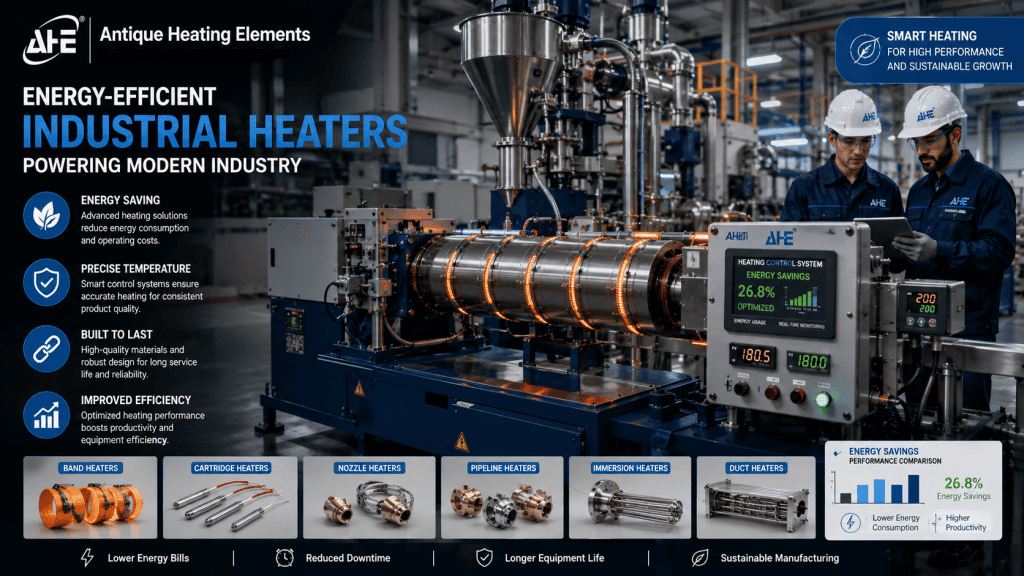
Energy costs are one of the largest operational expenses for manufacturing companies. Rising electricity prices, increasing production demands, and sustainability goals have forced industries to focus on improving energy efficiency without compromising productivity.
One of the most overlooked opportunities for energy savings lies in industrial heating systems.
Industrial heaters are used across nearly every manufacturing sector, including plastics, packaging, food processing, pharmaceuticals, chemicals, textiles, and automotive industries. When properly selected and maintained, modern industrial heaters can significantly reduce energy consumption while improving production quality and operational efficiency.
In this comprehensive guide, we explain how industrial heaters improve energy efficiency in manufacturing, what technologies are driving energy savings, and how businesses can reduce operating costs through smarter heating solutions.
🔥 How Do Industrial Heaters Improve Energy Efficiency?
Industrial heaters improve energy efficiency by delivering precise temperature control, reducing heat loss, minimizing energy waste, and improving thermal transfer. Modern industrial heating systems consume less power while maintaining consistent production temperatures, resulting in lower operating costs and higher manufacturing productivity.
Why Energy Efficiency Matters in Manufacturing
Energy efficiency has become a major competitive advantage.
Manufacturers today face challenges such as:
- Rising electricity costs
- Environmental regulations
- Production cost pressures
- Sustainability targets
- Increased competition
A reduction of even 10–20% in energy consumption can generate substantial annual savings for industrial facilities.
For many manufacturing plants, heating systems account for 30% to 60% of total energy usage.
This makes industrial heaters one of the most important areas for optimization.
Understanding Industrial Heating Systems
Industrial heaters generate thermal energy required for various manufacturing processes.
Common applications include:
- Plastic processing
- Injection molding
- Extrusion
- Packaging machinery
- Food production
- Chemical processing
- Pharmaceutical manufacturing
- Industrial drying
The efficiency of these systems directly affects:
✔ Production speed
✔ Product quality
✔ Equipment lifespan
✔ Energy consumption
✔ Operating costs
The Relationship Between Heat and Energy Consumption
Heat is essential in manufacturing, but inefficient heat generation results in wasted energy.
When heating systems operate inefficiently, industries experience:
❌ Excessive electricity consumption
❌ Temperature fluctuations
❌ Longer production cycles
❌ Increased maintenance costs
❌ Lower product quality
Modern industrial heaters are designed to maximize heat transfer while minimizing energy losses.
1. Precise Temperature Control Reduces Energy Waste
One of the biggest advantages of modern industrial heaters is accurate temperature control.
Older heating systems often:
- Overheat materials
- Require manual adjustment
- Waste electricity
Modern heaters use:
- PID controllers
- Thermocouples
- Smart sensors
- Digital temperature controls
These technologies maintain exact temperatures throughout production.
Benefits
✔ Reduced power consumption
✔ Better product consistency
✔ Faster processing
✔ Lower scrap rates
For example, plastic injection molding machines require precise barrel temperatures. Even slight temperature variations can affect product quality and increase energy usage.
2. Better Heat Transfer Efficiency
Industrial heaters are designed to transfer heat efficiently to the target material.
Different heater types offer different levels of efficiency.
Common Heater Types
Band Heaters
Used on:
- Injection molding machines
- Extrusion barrels
- Plastic processing equipment
Cartridge Heaters
Used in:
- Molds
- Dies
- Packaging machinery
Coil Heaters
Used in:
- Hot runner systems
- Nozzle heating applications
Ceramic Heaters
Known for:
- Superior insulation
- Reduced heat loss
- Energy savings
3. Reduced Heat Loss Through Advanced Insulation
Heat loss is one of the largest sources of wasted energy in manufacturing facilities.
Traditional heaters lose substantial heat to the surrounding environment.
Modern industrial heaters utilize:
- Ceramic insulation
- Mineral insulation
- Reflective thermal barriers
- High-efficiency jackets
Benefits
✔ Lower power consumption
✔ Faster heating
✔ Improved workplace comfort
✔ Reduced equipment strain
Some ceramic-insulated heaters can reduce heat loss by up to 30% compared to conventional systems.
4. Faster Heating Means Lower Energy Usage
Many manufacturers assume that slower heating saves energy.
In reality, faster and more efficient heating often consumes less total power.
Modern industrial heaters offer:
- High watt density
- Rapid thermal response
- Efficient heat transfer
This allows equipment to reach operating temperature faster.
Results
✔ Reduced startup time
✔ Lower energy consumption
✔ Increased production output
✔ Reduced idle energy losses
5. Smart Heating Technology Optimizes Performance
Industry 4.0 has transformed industrial heating systems.
Modern smart heaters now integrate:
- IoT monitoring
- Real-time diagnostics
- Predictive maintenance
- Automated temperature adjustments
These systems continuously monitor performance and optimize energy use.
Advantages
✔ Reduced downtime
✔ Lower maintenance costs
✔ Better energy management
✔ Increased equipment lifespan
6. Reduced Production Downtime Saves Energy
Equipment failures often lead to:
- Production interruptions
- Energy waste
- Product scrap
Efficient industrial heaters improve reliability and reduce unexpected downtime.
When machines operate consistently:
✔ Less restart energy is required
✔ Production schedules remain stable
✔ Operational efficiency improves
7. Improved Product Quality Reduces Waste
Poor temperature control creates manufacturing defects.
Examples include:
Plastic Industry
- Warping
- Surface defects
- Dimensional inaccuracies
Packaging Industry
- Weak seals
- Product contamination
Food Industry
- Uneven cooking
- Quality inconsistencies
Every defective product represents wasted materials and wasted energy.
Modern heating systems improve consistency and reduce rejection rates.
Energy Efficiency Benefits in Different Industries
Plastic Manufacturing Industry
Industrial heaters are essential for:
- Injection molding
- Blow molding
- Extrusion
Energy-efficient heaters provide:
✔ Uniform barrel heating
✔ Reduced cycle times
✔ Lower electricity costs
Packaging Industry
Packaging machines rely heavily on heaters.
Applications include:
Efficient heating improves:
✔ Seal quality
✔ Machine speed
✔ Energy savings
👉 Related solutions:
Sealing Machine Manufacturer
Food Processing Industry
Food manufacturers use industrial heaters for:
- Drying
- Baking
- Packaging
- Sterilization
Energy-efficient systems improve:
✔ Product quality
✔ Hygiene standards
✔ Operating costs
Pharmaceutical Industry
Precise heating is critical for:
- Chemical reactions
- Sterilization
- Packaging
Efficient heaters ensure compliance and process accuracy.
How to Improve Industrial Heater Efficiency
Manufacturers can further improve efficiency by following best practices.
Regular Maintenance
Routine inspections help prevent efficiency losses.
Maintenance Checklist
✔ Inspect wiring
✔ Clean heating surfaces
✔ Test insulation resistance
✔ Check temperature sensors
✔ Replace worn components
Upgrade Old Heating Systems
Older heaters consume more electricity and provide less performance.
Modern replacements offer:
✔ Better insulation
✔ Improved heat transfer
✔ Smart controls
✔ Longer lifespan
Use Proper Heater Sizing
Oversized heaters waste energy.
Undersized heaters struggle to maintain temperature.
Always select heaters based on:
- Application
- Material type
- Temperature requirements
- Production volume
Future Trends in Energy-Efficient Industrial Heating
The future of industrial heating includes:
Smart Heater Monitoring
Real-time performance tracking.
AI-Based Temperature Control
Automated optimization of heating cycles.
Sustainable Manufacturing
Reduced carbon emissions through energy-efficient heating systems.
Advanced Ceramic Technologies
Improved insulation and lower operating costs.
Why Choose Antique Heating Elements?
At Antique Heating Elements, we manufacture industrial heating solutions designed to maximize efficiency and performance.
Our Product Range
- Band Heaters
- Cartridge Heaters
- Coil Heaters
- Ceramic Heaters
- Infrared Heaters
- Tubular Heaters
- Sealing Machines
Benefits
✔ Energy-efficient designs
✔ Reliable performance
✔ Custom manufacturing
✔ Long service life
✔ PAN India support
Conclusion
Industrial heaters play a critical role in improving manufacturing efficiency, reducing operational costs, and supporting sustainable production practices.
Modern energy-efficient heating systems provide:
✔ Precise temperature control
✔ Faster heating
✔ Reduced heat loss
✔ Lower energy consumption
✔ Improved product quality
✔ Higher productivity
As energy costs continue to rise, investing in high-quality industrial heating solutions is one of the smartest decisions manufacturers can make.
❓ Frequently Asked Questions
Q1. How do industrial heaters save energy?
Industrial heaters save energy through efficient heat transfer, better insulation, precise temperature control, and reduced heat loss.
Q2. Which industrial heater is the most energy efficient?
Ceramic heaters and high-density cartridge heaters are among the most energy-efficient industrial heating solutions.
Q3. Can industrial heaters reduce manufacturing costs?
Yes. Energy-efficient heaters reduce electricity consumption, maintenance costs, and production downtime.
Q4. How often should industrial heaters be maintained?
Industrial heaters should be inspected monthly and serviced regularly to maintain peak efficiency.
Q5. Why is temperature control important in manufacturing?
Accurate temperature control improves product quality, reduces waste, and minimizes energy consumption.
